

Location – 3-6-25 Shiba Koen Minato-Ku, Tokyo, Japan 105-0011
Website – https://saintalbansnursery.com/
Contact – 070-3522-0720
Hidden behind a green oasis off the streets that encircle Tokyo Tower, St. Alban’s Nursery School is a cherished institution for more than half a century—a haven of warmth, diversity, and creativity in one of the planet’s most frenetic cities. Established in 1972 by St. Alban’s Anglican-Episcopal Church women, the school was a direct response to a simple need: to build an English-language supportive preschool community for their children when there were few, or maybe no, such schools in Tokyo.
The small, community-based origin has evolved into one of Tokyo’s most esteemed early childhood learning communities, recognized for its family environment, open education, and global character.
A Legacy of Love, Learning, and Community
St. Alban’s Nursery has been based at the same idyllic parish hall for more than 50 years. The tree-lined and serene church garden encircles the school’s large playground, which has become its defining feature—a free area where children play, learn, and grow.
In spite of Tokyo’s urbanization, St. Alban’s maintained its serene, community-oriented nature. The school still reflects its founding principles of care, community, and lifelong learning.
Small School, Big Heart
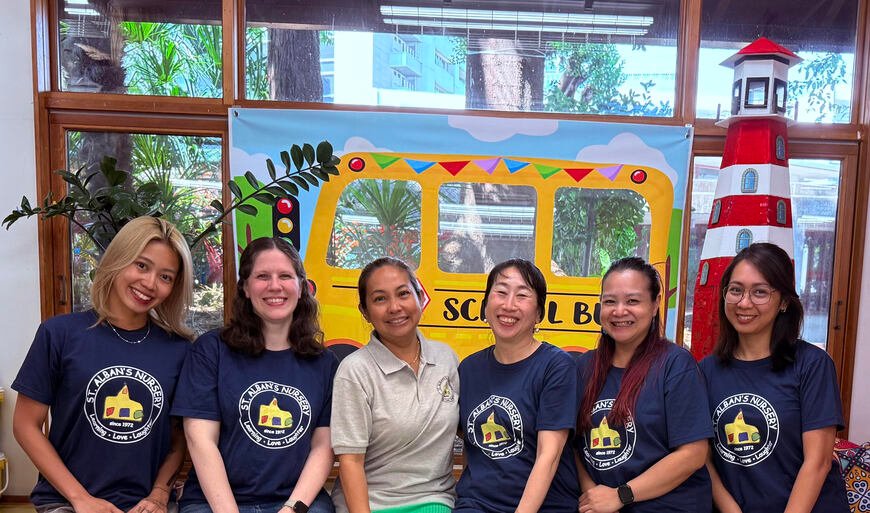
The most distinctive feature of St. Alban’s Nursery is its small class size. With only 25 children and six full- and part-time staff, every child receives personalized care and attention. The co-aged room, aged 1.5 to 5 years, enables older children to mentor younger ones, teaching them empathy, patience, and cooperation.
It is this “small is beautiful” philosophy that guides the success of the school. One of Tokyo’s better value English-language preschools, graduates of St. Alban’s automatically qualify for top international schools—a reflection of the school’s dedication to excellence in early childhood education.
A Safe and Nurturing Environment
Emotional well-being and safety form the cornerstone of St. Alban’s philosophy. With a low pupil-to-teacher ratio, each child is cared for with individual attention, and mixed-age group interaction encourages tolerance, kindness, and respect. Teachers support children in emotional expression, conflict resolution, and social duty to enable them to learn basic self-help and life skills.
Physical safety, particularly during outdoor play and outings, is of great concern. The nurturing environment encourages children to become confident, independent, and empathetic.
A Montessori-Inspired Approach to Learning
Learning at St. Alban’s is hands-on, interactive, and fun. The school’s Montessori-inspired curriculum combines self-directed learning with systematic thematic teaching. A principal theme each week ties activities in subjects together to present learning in an ordered and interesting way.
The curriculum blends Montessori self-directed discovery and learning with STEAM and Creative Curriculum. Dramatic arts, geography, and science are integrated into weekly lessons through balance of curiosity, problem-solving, and creativity.
Blending Technology and Tradition
St. Alban’s cherishes hands-on learning of the traditional variety but also appreciates the value of digital literacy. Technology is intentionally introduced and in moderation—as an adjunct to, not a substitute for, hands-on learning.
They learn in brief increments with laptops and learning programs to build strong early numeracy and literacy skills, but the bulk of their learning is hands-on and social—story, art, block building, imaginative play. That intentional blend of both enables students to build critical 21st-century skills without sacrificing the beauty of discovery.
Learning Through Nature
Few Tokyo preschools are as lucky as having a private tree-lined garden inside the city. St. Alban’s maximizes its natural resources by conducting daily programs outdoors to allow children to reconnect with nature.
Day and night, children come to the garden as a living classroom where they plant and harvest vegetables such as potatoes and cucumbers, learn about changes in season, and gather leaves. They also conduct outdoor science experiments and gardening activities to develop curiosity, hand-eye coordination, and sensitivity to nature.
These lessons learn not just science but appreciation—appreciation of the rhythm of nature, beauty, and harmony.
A Celebration of Diversity and Inclusion
Multiculturalism is at the heart of St. Alban’s Nursery’s identity. Educators and parents of various nationalities, religion, and backgrounds constitute the school community, reflecting the multicultural face of modern Tokyo.
Children from mixed-heritage homes feel embraced, and children with special learning difficulties are given special attention so that they can confidently integrate into mainstream school. This is an inclusive attitude that goes far beyond the classroom context.
Involving Parents as Partners
St. Alban’s discovers that learning in a child is most powerful when parents are involved as active partners. Teachers provide daily reports of progress at drop-off and pick-up times, keeping the lines of communication open between home and school.
Additionally, parent-teacher conferences held twice a year offer in-depth feedback regarding each child’s growth, strengths, and weaknesses. Parents also get to accompany field trips and community events at school, complementing the family-oriented atmosphere that characterizes St. Alban’s community.
Special Programs and Enrichment Activities
There is a lot of scope for creativity, expression, and enjoyment in the school calendar. Special season programs, e.g., a one-week Winter Program and a four-week Summer Program, full of theme-based activities and outdoor activities, are organized by St. Alban’s.
Amongst the normal curriculum, enrichment of course figures. The children appreciate drama lessons from a visiting teacher, building towards confidence, expression, and collaboration. The church organist pays visits every other fortnight to provide music lessons, with children singing in English and Japanese—more often than not rehearsing for the famous Christmas Concert and Graduation Ceremony.
These activities bring about an appreciation of art and public speaking at early ages.
Keeping True to Its Roots
Whereas other schools would need to grow, St. Alban’s Nursery is purposefully small. The school is not interested in growing but in growing the quality of education as well as richness of experience of each child.
Looking forward, St. Alban’s continues with its purpose: to cultivate confident, empathetic, and creative young minds who can thrive anywhere in the world but remain rooted in strong foundations of giving and questioning.
Conclusion
Since more than half a century, St. Alban’s Nursery School has stood as an exemplar of what nursery school can be: warm, happy, welcoming, and full of humanity. Among the garden foliage of its campus and in its cozy classrooms, children don’t merely prepare for school—they embark on a lifetime of exploration, friendship, and learning.
In a changing world, St. Alban’s is still a place where small is beautiful—where every child knows that he is loved and encouraged to grow.